Home › Blog › How to Calculate GPA
How-To GuideHow to Calculate GPA Step by Step — Complete Guide with Examples (2026)
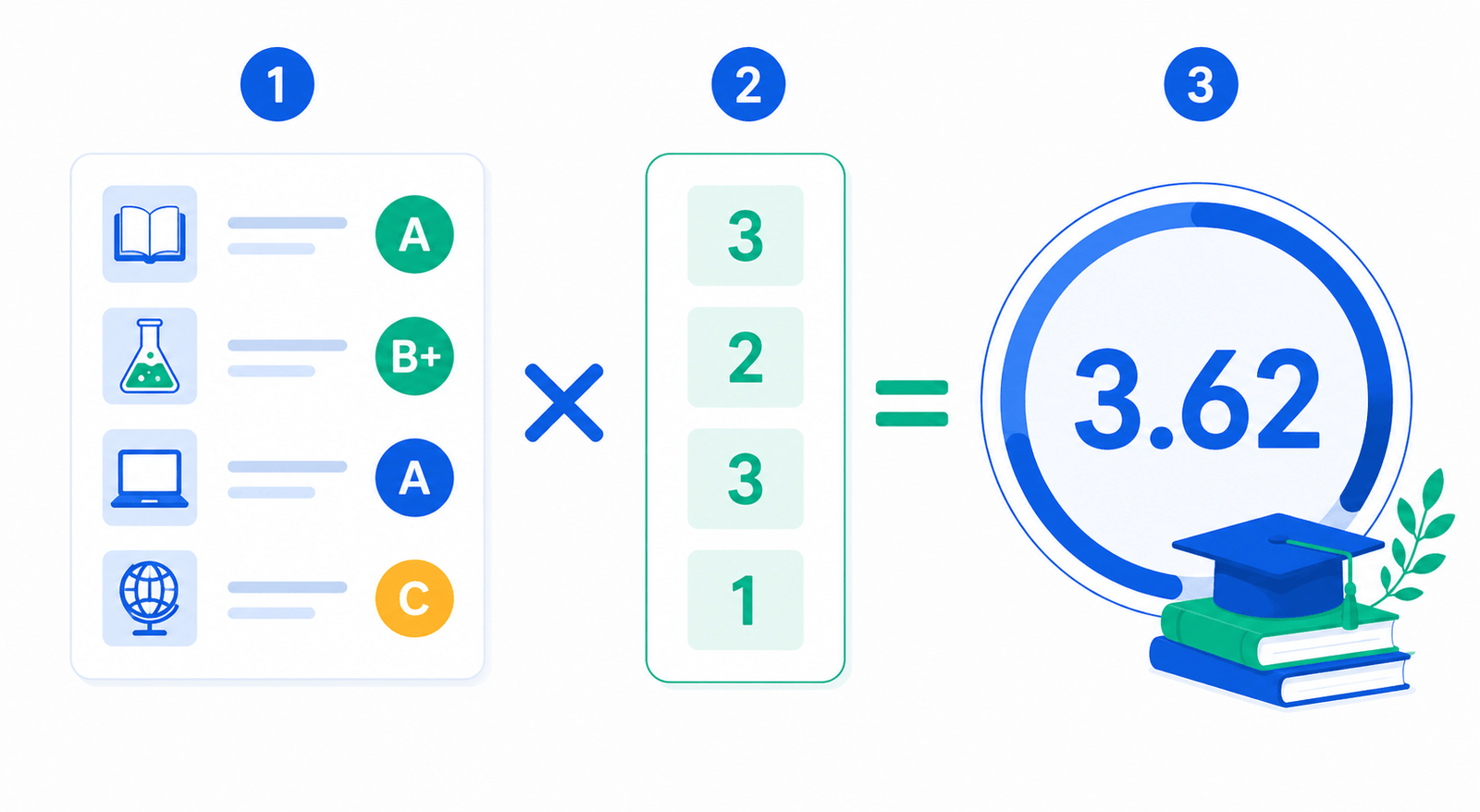
Calculating your GPA is one of the most practically valuable academic skills a Pakistani university student can develop. When you understand the formula deeply — not just how to plug numbers into it, but why it works the way it does — you gain the ability to estimate your grade before results are released, identify which courses need the most attention, plan your study time intelligently, verify the official figures on your transcript, and model how different academic scenarios will affect your cumulative standing.
This comprehensive guide covers the complete GPA calculation process from start to finish. We begin with the conceptual foundation — understanding what GPA actually measures and why the weighted average structure matters — then walk through the step-by-step formula with six fully worked examples representing different Pakistani university programmes and performance scenarios. We also cover CGPA calculation, common errors that invalidate manual calculations, how to verify your results against official records, and strategic applications of the calculation knowledge for academic planning. By the end, you will have complete mastery of GPA calculation and its practical implications.
Why Understanding the GPA Formula Matters Beyond Just Getting a Number
Many students treat GPA as a number that simply appears on their marksheet at the end of the semester — something that happens to them rather than something they actively shape. This passive orientation is one of the most avoidable sources of academic underperformance in Pakistani universities.
When you truly understand how GPA is calculated, your relationship with your academic performance changes fundamentally. You realise that a 4-credit course and a 1-credit course are not equally important to your GPA — and this changes how you allocate study time. You understand that submitting every assignment and attending every quiz, even in subjects where you feel confident, protects your grade with mathematical certainty. You can calculate, before finals season, exactly what score you need on your final exam to achieve your target letter grade in each course. You can model how an F in one course affects your overall GPA and make strategic decisions about whether to withdraw from a course versus risk the grade. None of these strategic applications are possible without understanding the underlying calculation.
The Foundational Concept: Why GPA is a Weighted Average
Before diving into the calculation steps, it is essential to understand the conceptual structure of GPA. GPA is not a simple average of your grades — it is a weighted average where the weight of each course is determined by its credit hours.
To understand why this matters, consider two students who both took four courses and received identical grades (A, B+, B, C). Student A's courses carried 4, 3, 2, 2 credit hours respectively. Student B's courses carried 2, 2, 2, 2 credit hours. Despite identical grades, Student A will have a different GPA than Student B, because Student A's A grade in the 4-credit course has much greater impact on the average than Student B's A grade in the 2-credit course.
This weighting is not arbitrary — it reflects the genuine academic reality that a course requiring four hours of class time per week and substantial outside work should count more toward your academic average than a course meeting once a week. Understanding and internalising this principle is the foundation of all effective academic strategy at Pakistani universities.
Step-by-Step GPA Calculation — The Complete Process
Gather your course information
For each course, you need three pieces of information: (1) the letter grade you received, (2) the number of credit hours the course carries, and (3) your university's grade point value for that letter grade. You can find letter grades on your official marksheet or LMS portal. Credit hours appear on your course outline, LMS, or official transcript. Grade point values are in your university's Academic Regulations document.
Convert letter grades to grade points
Using your university's official grading table, write the grade point value next to each course's letter grade. For most Pakistani universities following HEC guidelines: A/A+ = 4.0, A- = 3.7, B+ = 3.3, B = 3.0, B- = 2.7, C+ = 2.3, C = 2.0, C- = 1.7, D = 1.0, F = 0.0. FAST-NUCES additionally has D+ = 1.3.
Calculate quality points for each course
For every course: Quality Points = Grade Points × Credit Hours. Write this calculation out for every single course, including lab courses. Do not skip any course that appears on your transcript with a grade and credit hours.
Sum quality points and credit hours separately
Add up all quality points from every course to get Total Quality Points. Add up all credit hours from every course to get Total Credit Hours. Keep these as separate running totals.
Divide and round
GPA = Total Quality Points ÷ Total Credit Hours. Round the result to two decimal places. This is your semester GPA on the 4.0 scale.
Pakistan's Standard Grading Scale — Full Reference
The following table is the HEC-recommended grading scale used by most Pakistani universities. Always verify with your specific university's Academic Regulations — FAST-NUCES, LUMS, and IBA Karachi have policy variations.
| Letter Grade | Grade Points (4.0) | Percentage Range | Academic Meaning | Career Signal |
|---|---|---|---|---|
| A+ / A | 4.0 | 85–100% | Outstanding / Excellent | Top scholar, Dean's List |
| A- | 3.7 | 80–84% | Very Good | Strong performer |
| B+ | 3.3 | 75–79% | Good | Above average |
| B | 3.0 | 70–74% | Above Average | Solid performance |
| B- | 2.7 | 65–69% | Average | Meets expectations |
| C+ | 2.3 | 60–64% | Satisfactory | Below expectations |
| C | 2.0 | 55–59% | Acceptable | Minimum standard |
| C- | 1.7 | 50–54% | Marginal Pass | At risk of problems |
| D | 1.0 | 45–49% | Passing | Should consider repeating |
| F | 0.0 | Below 45% | Fail | Must repeat course |
Six Fully Worked Examples Across Different Programmes
Example 1 — BS Computer Science (Strong Semester)
A FAST-NUCES student's Semester 4 results:
| Course | Grade | Grade Pts | Credit Hrs | Quality Pts |
|---|---|---|---|---|
| Database Systems | A | 4.0 | 3 | 12.0 |
| DB Lab | A | 4.0 | 1 | 4.0 |
| Operating Systems | A- | 3.7 | 3 | 11.1 |
| Design and Analysis of Algorithms | B+ | 3.3 | 3 | 9.9 |
| Software Engineering | A- | 3.7 | 3 | 11.1 |
| Technical and Business Writing | A | 4.0 | 2 | 8.0 |
| TOTALS | 15 | 56.1 |
GPA = 56.1 ÷ 15 = 3.74 — an excellent semester, qualifying for the FAST Dean's List (requires 3.80 at FAST, so just below threshold). Semester CGPA impact: this strong result will raise or maintain most students' cumulative average.
Example 2 — BS Electrical Engineering (Mixed Performance)
A NUST student's Semester 3 results with some struggling courses:
| Course | Grade | Grade Pts | Credit Hrs | Quality Pts |
|---|---|---|---|---|
| Circuit Analysis II | B- | 2.7 | 3 | 8.1 |
| Electronics Lab | B | 3.0 | 1 | 3.0 |
| Signals and Systems | C+ | 2.3 | 3 | 6.9 |
| Engineering Mathematics III | B | 3.0 | 4 | 12.0 |
| Digital Electronics | B+ | 3.3 | 3 | 9.9 |
| Pakistan Studies | A- | 3.7 | 2 | 7.4 |
| TOTALS | 16 | 47.3 |
GPA = 47.3 ÷ 16 = 2.956 ≈ 2.96 — a B- average. Note how the 4-credit Engineering Mathematics course (even at a B = 3.0) significantly pulls the average. If this student had earned A- instead of B in Engineering Mathematics, their GPA would increase to: (47.3 − 12.0 + 14.8) ÷ 16 = 50.1 ÷ 16 = 3.13. A single grade improvement in the highest-credit course raises the GPA by 0.17 points.
Example 3 — BS Agriculture (UAF, Lab-Heavy Semester)
A UAF Semester 1 student showing how labs affect GPA:
| Course | Type | Grade | Grade Pts | Credit Hrs | Quality Pts |
|---|---|---|---|---|---|
| Fundamentals of Agronomy | Theory | B+ | 3.3 | 3 | 9.9 |
| Agronomy Lab | Lab | A- | 3.7 | 1 | 3.7 |
| Agricultural Botany | Theory | B | 3.0 | 2 | 6.0 |
| Botany Lab | Lab | A | 4.0 | 1 | 4.0 |
| Agricultural Chemistry | Theory | B- | 2.7 | 3 | 8.1 |
| Chemistry Lab | Lab | B+ | 3.3 | 1 | 3.3 |
| English Composition | Theory | A- | 3.7 | 2 | 7.4 |
| Islamic Studies | Theory | A | 4.0 | 2 | 8.0 |
| TOTALS | 15 | 50.4 |
GPA = 50.4 ÷ 15 = 3.36 — a solid B+ average. Notice how the lab courses (3 labs, each earning above-theory-average grades of A and A-) help pull the overall GPA upward. Without the labs, the theory-only GPA would be: (50.4 − 3.7 − 4.0 − 3.3) ÷ 12 = 39.4 ÷ 12 = 3.28. Labs added 0.08 GPA points — a meaningful contribution across a full programme.
Example 4 — BBA Business (Punjab University)
A PU business student's Semester 5:
| Course | Grade | Grade Pts | Credit Hrs | Quality Pts |
|---|---|---|---|---|
| Financial Management | B+ | 3.3 | 3 | 9.9 |
| Marketing Management | A- | 3.7 | 3 | 11.1 |
| Business Research Methods | B | 3.0 | 3 | 9.0 |
| Entrepreneurship | A | 4.0 | 2 | 8.0 |
| Organisational Behaviour | B+ | 3.3 | 3 | 9.9 |
| Business Communication | A- | 3.7 | 2 | 7.4 |
| TOTALS | 16 | 55.3 |
GPA = 55.3 ÷ 16 = 3.456 ≈ 3.46 — an excellent B+ average, solidly in the distinction range.
Example 5 — A Recovery Scenario (Difficult Semester)
A student struggling with core courses:
| Course | Grade | Grade Pts | Credit Hrs | Quality Pts |
|---|---|---|---|---|
| Differential Equations | D | 1.0 | 3 | 3.0 |
| Thermodynamics | C | 2.0 | 3 | 6.0 |
| Engineering Drawing | B | 3.0 | 2 | 6.0 |
| Drawing Lab | B+ | 3.3 | 1 | 3.3 |
| Basic Electronics | C+ | 2.3 | 3 | 6.9 |
| English Literature | B- | 2.7 | 2 | 5.4 |
| TOTALS | 14 | 30.6 |
GPA = 30.6 ÷ 14 = 2.186 ≈ 2.19 — a difficult semester that will noticeably damage the student's CGPA. The D in Differential Equations (3 credits, only 3.0 quality points) is the most damaging element — if this student had earned B (3.0) instead of D (1.0), their GPA would have been: (30.6 − 3.0 + 9.0) ÷ 14 = 36.6 ÷ 14 = 2.61. This student should strongly consider repeating Differential Equations in the next semester.
Example 6 — CGPA Calculation Across 4 Semesters
Using the results from Examples 1, 3, 4, and 5 above to calculate a hypothetical student's CGPA:
| Semester | Semester GPA | Credit Hours | Weighted Points | Running CGPA |
|---|---|---|---|---|
| Semester 1 (Example 3) | 3.36 | 15 | 50.40 | 3.36 |
| Semester 2 (Example 4 variation) | 3.20 | 14 | 44.80 | 3.28 |
| Semester 3 (Example 5) | 2.19 | 14 | 30.66 | 2.94 |
| Semester 4 (Example 1 variation) | 3.74 | 15 | 56.10 | 3.12 |
| Total | 58 | 181.96 | 3.14 |
CGPA = 181.96 ÷ 58 = 3.14. The weak Semester 3 (2.19 GPA) dropped the CGPA from 3.28 to 2.94 — a decline of 0.34 points — and despite a very strong Semester 4 (3.74 GPA), the CGPA only recovered to 3.14. This recovery required a 3.74 semester GPA, and still left the student 0.14 points below where they were before Semester 3. Use our CGPA Calculator to run your own multi-semester calculations instantly.
How to Find Your Credit Hours — University by University
Credit hours are assigned to each course based on the weekly contact hours and expected workload. Knowing where to find accurate credit hour information for your specific courses is essential for correct GPA calculation.
Course Outline (Syllabus)
At the start of each semester, every registered course should provide a course outline document that specifies the course title, course code, credit hours, instructor, assessment breakdown, and weekly topic schedule. Credit hours are always stated prominently in this document — typically at the top of the first page. If you do not have the course outline, request it from your instructor or department.
University LMS Portal
Most Pakistani universities use Learning Management Systems (LMS) — Canvas, Blackboard, Moodle, or locally developed systems — where each enrolled course is listed with its credit hours. This is often the most convenient source because all your courses for the current semester are visible in one place.
Official Transcript
Your semester marksheet and official transcript list each course with its credit hours alongside the grade. This is the most authoritative source for historical courses and for verifying your GPA calculations against official records.
University Timetable / Programme Structure
Your department's official programme structure document — typically available on the university website or from the academic office — lists all courses in the programme with their credit hours. This is useful for planning future semesters and understanding the credit distribution across your degree.
Common Calculation Errors and How to Avoid Them
Error 1: Using Simple Average Instead of Weighted Average
This is the most common and consequential calculation error. Students add up grade points and divide by the number of courses, ignoring credit hours entirely. This produces a meaningfully different — and incorrect — result whenever courses carry different credit hours (which is virtually always).
Wrong: (4.0 + 3.3 + 2.7 + 3.7 + 4.0) ÷ 5 = 3.54
Correct (credit hours 3, 3, 3, 2, 2): (12.0 + 9.9 + 8.1 + 7.4 + 8.0) ÷ 13 = 45.4 ÷ 13 = 3.49
The difference here is 0.05 points — enough to change your grade classification or CGPA category. Always multiply grade points by credit hours before summing.
Error 2: Excluding Lab Courses
Lab courses (1 credit hour each) must be included in GPA calculations. They appear on your transcript with grades and credit hours and contribute quality points to your total. Students who exclude labs from their manual calculation get both the quality points numerator and the credit hours denominator wrong, producing an incorrect GPA estimate. Include every course that appears on your transcript with a letter grade and credit hours — no exceptions.
Error 3: Using Wrong Grade Point Values
FAST-NUCES uses a D+ grade worth 1.3 points absent from most other scales. LUMS and IBA use relative grading where raw marks do not directly determine letter grades. Some older Pakistani universities may use slightly different percentage-to-grade boundaries than the standard HEC table. Always verify your specific institution's official grade point assignments rather than assuming the generic table applies.
Error 4: Rounding Quality Points Before Summing
Do not round individual quality points to one or two decimal places before computing the total. Keep full decimal precision through all intermediate calculations and only round the final GPA result to two decimal places. Rounding intermediates introduces compounding errors that can shift your final GPA by 0.02 to 0.05 points.
Wrong: Round 3.7 × 3 = 11.1 → 11, then sum rounded values
Correct: Keep 11.1, sum all unrounded values, then round only the final GPA
Error 5: Including Non-Credit or Pass/Fail Courses
Some courses — particular co-curricular activities, zero-credit seminars, or courses taken on a pass/fail basis — appear on transcripts but carry no credit hours and are not included in GPA calculations. Check whether each course on your transcript has credit hours and a letter grade; if it shows "P/F" (Pass/Fail) or "0 credits," exclude it from the calculation.
Error 6: Wrong Semester for CGPA
When calculating CGPA manually, students sometimes include a course in multiple semesters (e.g., calculating the same course twice if it appears on multiple versions of their results) or exclude courses from a semester they forgot to account for. Use your official cumulative transcript — not individual semester marksheets — as the single source of truth for CGPA calculations, and verify that each course appears exactly once.
How to Verify Your Calculation Against Official Records
After calculating your GPA manually, compare it against the official figure on your transcript. A discrepancy of ±0.01 is normal due to rounding differences between your method and your university's system. A discrepancy larger than ±0.05 should prompt investigation.
Systematic verification approach:
- List every course from your official transcript for the relevant semester
- Confirm the letter grade for each course matches your marksheet
- Confirm the credit hours match your course outline and timetable
- Verify the grade point values you used match your university's official scale
- Check your arithmetic — quality points calculations and the final division
- If discrepancy persists, contact your Registrar's Office with your original marksheets
Transcript errors, while uncommon, do occasionally occur — wrong grade entered by faculty, wrong credit hours in the system, data entry errors during grading. These can almost always be corrected by submitting documented evidence (your original marksheet or exam paper) to the Registrar's Office. Acting quickly matters: many universities have deadlines for requesting grade changes or transcript corrections.
Using GPA Calculation for Strategic Academic Planning
The most powerful application of understanding GPA calculation is not computing your past grade — it is predicting your future grades and making better decisions as a result.
Estimating Your GPA Before Results Are Released
After your final exam, you typically know your marks on quizzes, assignments, and midterm from previous announcements. You can estimate your final exam performance reasonably well. Plugging these estimates into the GPA formula gives you a realistic projection of your likely semester GPA — useful for planning and mental preparation, and sometimes for deciding whether to request remarking if the official result diverges significantly from your estimate.
Calculating the Grade Boundary Before Finals
Before each final exam, calculate the minimum score you need to achieve your target letter grade. This involves: (1) knowing your current marks from continuous assessment and midterm, (2) knowing the weight of the final exam, and (3) knowing the percentage boundaries for each letter grade. If you need only 35% on the final to secure an A-, you can study with focus on reinforcing existing knowledge. If you need 85% on the final just to pass, you know you must invest every available study hour in that subject and potentially adjust your grade targets in other courses.
Modelling Course Repeat Scenarios
If you received a low grade in a previous semester and are considering repeating the course, you can precisely calculate the CGPA impact of the improvement. For example: if you have completed 60 credits with CGPA 2.80, and you repeat a 3-credit course improving from D (1.0) to B+ (3.3), your new CGPA will be: ((2.80 × 60) − (1.0 × 3) + (3.3 × 3)) ÷ 60 = (168.0 − 3.0 + 9.9) ÷ 60 = 174.9 ÷ 60 = 2.915. An improvement from 2.80 to 2.92 — meaningful and achievable. Use our CGPA Calculator to model this accurately.
Planning How Many Credits to Take Per Semester
In some circumstances — particularly for students on academic recovery programmes or managing significant external pressures — taking a reduced course load may be preferable to overloading and performing poorly. The GPA mathematics are unambiguous: six courses with B+ averages produces a better semester GPA than eight courses where you earn A in two and C in six. Understanding the weighted average structure allows you to make informed decisions about course load rather than assuming more courses always means better progress.
The Relationship Between Assessment Components and GPA
Pakistani university courses are almost universally assessed through multiple components that together determine your final letter grade and grade points. Understanding how these components combine is important for GPA planning.
The typical assessment structure at Pakistani universities is:
| Assessment Component | Typical Weight Range | Timing | Control Level |
|---|---|---|---|
| Quizzes (4–6 per semester) | 10–15% | Throughout semester | Very High |
| Assignments (2–5 per semester) | 10–15% | Throughout semester | Very High |
| Midterm Examination | 25–35% | Weeks 6–9 | Medium-High |
| Final Examination | 40–50% | End of semester | Medium |
| Lab / Practical Work | Varies (for lab courses) | Weekly | Very High |
The "Control Level" column reflects how predictable your score in each component is given consistent effort. Quizzes and assignments have very high predictability — if you prepare properly and submit on time, you will consistently earn high marks. Final examinations have medium predictability because performance depends on exam difficulty, question selection, and day-of-performance factors beyond your control. The strategic implication: maximise your marks on the high-control components (quizzes, assignments, labs) because these build a buffer that reduces the pressure on the lower-control exam components.
How to Use Our GPA Calculator Effectively
Our free GPA Calculator simplifies the entire calculation process. Here is how to use it most effectively:
- Enter each course name for easy reference in the results breakdown
- Select the letter grade from the dropdown for each course
- Enter the credit hours carefully — verify from your course outline
- Add rows for every course including labs and non-major courses
- Click Calculate to see your GPA and the full quality-point breakdown
- Use the Print Result button to save a copy for reference
For CGPA across multiple semesters, use our CGPA Calculator which lets you enter each semester's GPA and credit hours for an instant cumulative calculation. For quick conversions, use the Percentage to GPA Converter.
Special Cases and Edge Conditions
What if I Withdrew from a Course?
A course withdrawal (W grade) that occurred before the withdrawal deadline typically does not appear in GPA calculations — the course is removed from your academic record for GPA purposes. A withdrawal after the deadline may result in a WF (Withdrawal Fail), which is treated as an F (0.0) for GPA purposes. Verify your university's specific withdrawal policy and deadline before deciding to withdraw from a course.
What About Incomplete Grades?
An Incomplete (I) grade may be assigned when a student cannot complete course requirements due to extenuating circumstances (illness, family emergency) and the instructor agrees to grant additional time. An I grade is typically converted to an F after a specified period if the work is not completed. While an I grade is pending, most universities exclude it from GPA calculations — but this varies by institution. Check your university's Academic Regulations for the specific treatment of incomplete grades.
How Does a Repeated Course Affect Calculations?
When you repeat a course and the new grade replaces the old, the calculation effectively removes the old grade's quality points and substitutes the new ones, while keeping the credit hours the same. If you improved from D (1.0) to B (3.0) in a 3-credit course: remove 1.0 × 3 = 3.0 old quality points, add 3.0 × 3 = 9.0 new quality points — a net gain of 6.0 quality points in your cumulative total without changing your total credit hours. Your CGPA increases accordingly.
Transfer Credits and Exchange Programme Courses
Credits transferred from other institutions, or courses taken as part of exchange programmes, may be treated differently in GPA calculations depending on your university's policy. Some institutions include transfer credits in GPA calculations (using the transfer grade point values mapped to their own scale); others record transferred credits separately without including them in the GPA calculation. Always clarify with your Registrar's Office how transferred credits will affect your CGPA.
GPA Calculation Across Different Pakistani University Systems
While the formula is identical across all Pakistani universities, the input values (grade points and minimum passing marks) vary. Here is how the calculation differs at Pakistan's main institutions:
| University | Min Pass Grade | D+ Grade? | A+ = A in Points? | Grading Style |
|---|---|---|---|---|
| NUST | D (50%) | No | Yes (both = 4.0) | Absolute |
| LUMS | D (50%) | No | Yes | Relative (curved) |
| FAST-NUCES | D (40%) | Yes (1.3) | N/A — no A+ grade | Absolute |
| UAF | D (50%) | No | Yes | Absolute |
| Punjab University | D (50%) | No | Yes | Absolute |
| COMSATS | D (50%) | No | Yes | Absolute |
| IBA Karachi | D (50%) | No | Yes | Relative (curved) |
Frequently Asked Questions About GPA Calculation
Q: Should I include zero-credit courses in my GPA calculation?
No. Zero-credit courses do not contribute to GPA calculations. They carry no credit hours, so multiplying any grade point value by zero always yields zero quality points. Excluding them from the calculation produces exactly the same result as including them. For practical purposes, identify courses with credit hours greater than zero as the only ones that matter for your GPA.
Q: My GPA shows 3.21 on my transcript but my calculation gives 3.23. Which is correct?
A difference of 0.02 is almost certainly a rounding difference rather than a genuine calculation error. Your university's GPA calculation system may use slightly different intermediate rounding steps. Both figures are essentially equivalent in meaning. If the difference were 0.10 or more, that would warrant investigation — verify your credit hours and grade point values against official records.
Q: I passed one course with 50% but it says C- on my transcript. Shouldn't that be at least C?
Passing marks and letter grade boundaries are not the same thing. At most Pakistani universities, 50–54% maps to C- (1.7 grade points), which is a passing grade (above the minimum of D/45–49%). Passing and the letter grade C (which requires 55–59%) are distinct. A C- is a legitimate passing grade that contributes 1.7 grade points per credit hour to your GPA calculation.
Q: Can I calculate my CGPA if I don't know my semester-by-semester GPAs?
Yes — you can calculate CGPA directly from cumulative totals. Sum all quality points earned across all semesters and divide by all credit hours earned. If your transcript shows cumulative quality points and cumulative credit hours, simply divide: CGPA = Cumulative Quality Points ÷ Cumulative Credit Hours. Many Pakistani university transcripts include these totals, making manual verification straightforward.
Q: How do I calculate GPA for a partial semester — before all results are released?
Calculate GPA using only the courses for which you have confirmed grades. For courses not yet graded, you can use estimated grades to project your likely GPA range. Our GPA Calculator works for any number of courses, so you can calculate with partial results and update as more grades become available.
Conclusion
Mastering GPA calculation is a foundational skill that pays dividends throughout your university career. When you can calculate your own GPA from raw marks — and understand why the weighted average structure works the way it does — you transform from a passive recipient of results into an active architect of your academic performance.
The five-step process is consistently the same: gather course data, convert grades to points, calculate quality points per course, sum everything, and divide by total credit hours. Apply this process to every semester, verify against your official transcript, and use the knowledge strategically — to prioritise high-credit courses, secure continuous assessment marks, plan course repeats, and set specific grade boundary targets before every examination.
Our free tools make all of this faster and more accurate:
- GPA Calculator — instant semester GPA with complete course breakdown
- CGPA Calculator — cumulative GPA across multiple semesters
- UAF GPA Calculator — for UAF students
- FAST GPA Calculator — for FAST-NUCES students
Questions? Email us at contact@techpot.site.
Why Manual GPA Calculation Matters Even When Calculators Are Available
Given that our free GPA Calculator can compute your GPA instantly and accurately, you might wonder why understanding the manual calculation process matters. There are three compelling reasons. First, understanding the formula allows you to mentally estimate your GPA mid-semester from partial data — before all grades are official — giving you actionable information weeks before your official results arrive. Second, it allows you to verify your official results against your own calculation, catching any errors in the official record before they become permanent. Third, it enables you to calculate "what-if" scenarios: if I improve this course from C+ to B, how much does my GPA change? This kind of real-time scenario analysis requires mathematical intuition that only comes from understanding the underlying formula.
GPA Calculation for Part-Time Students and Reduced Loads
Some Pakistani university students — particularly those managing work alongside studies, or students on academic recovery programmes — take reduced credit loads in certain semesters. The GPA formula works identically regardless of total credit load: quality points are summed and divided by total credits for that semester. However, reduced-load semesters at some universities may affect eligibility for academic honours (Dean's List typically requires a full course load) and may affect financial aid or scholarship eligibility. Reduced-load students should verify with their academic advisor whether their CGPA calculation method changes for reduced-load semesters — most institutions compute it identically, but verify rather than assume.
Understanding Grade Point Rounding in Official Systems
Pakistani university academic management systems (AMS) typically round grade points and quality points to two or three decimal places in intermediate calculations before computing the final GPA. Different systems use slightly different rounding conventions — some round at each intermediate step, others carry full precision through all calculations and round only the final result. This is why your manual calculation may differ from the official figure by ±0.01 to ±0.03 points — both can be mathematically correct depending on the rounding convention used. The official transcript figure is authoritative for all formal purposes; your manual calculation is for verification and scenario planning. A discrepancy larger than ±0.05 warrants investigation; smaller discrepancies are normal rounding differences.